
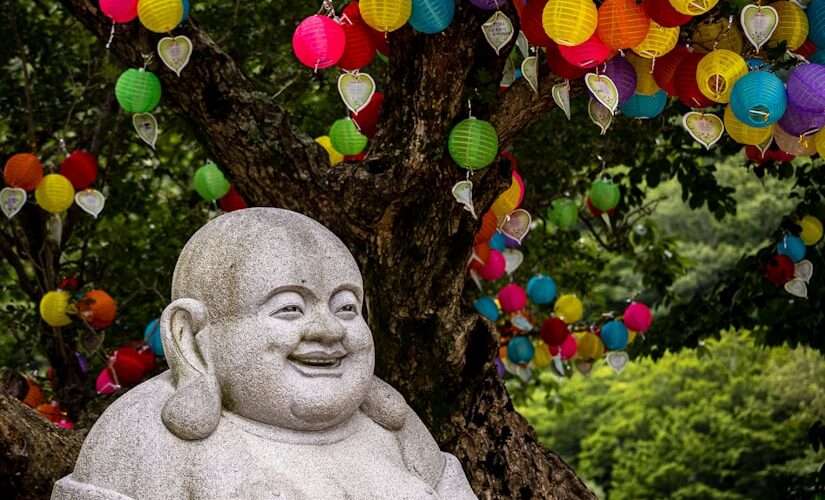
The key differences between the Buddha (Siddhartha Gautama) and Budai (the Laughing Buddha) are:
- Historical origins:
- The Buddha was the historical founder of Buddhism, who lived around 600 BC in India.
- Budai was a Chinese Zen monk who lived around the 10th century AD, over 1,600 years after the Buddha. He is a legendary, folkloric figure, not the historical Buddha.
- Physical appearance:
- The Buddha is typically depicted as a slim, ascetic figure in meditation.
- Budai is portrayed as a fat, jolly, laughing monk with a large belly and sack.
- Significance:
- The Buddha is the enlightened spiritual teacher whose teachings form the foundation of Buddhism.
- Budai is a symbol of happiness, contentment, and prosperity in Chinese folklore, not the historical Buddha.
In summary, the Buddha was the founder of Buddhism, while Budai is a separate, later Chinese folkloric figure often mistaken for the Buddha due to the shared title. The Buddha is depicted as a slim, meditative figure, while Budai is portrayed as a fat, laughing monk.
References:
https://www.worldtravelconnector.com/skinny-buddha-vs-fat-buddha-laughing/
https://nembutsu.cc/2021/08/12/one-of-these-buddhas-is-not-like-the-other/
Laughing Buddhas are beloved symbols in Buddhist culture, often being seen as symbols of contentment, happiness and abundance. Indeed, one popular misconception suggests that rubbing the fat & happy Buddha’s belly brings wealth & prosperity – yet this figure should not be mistaken for its founder; in actuality he’s actually one of several Bodhisattvas known as Budai or Angida who were instrumental in founding Buddhism!
The Buddha is widely recognized as an individual who attained Nirvana, as well as teaching others how to achieve it themselves. His laughter remains a poignant reminder that we should cherish what we have and share it with those around us; therefore he has become such an iconic symbol of joy, contentment, and good luck.

Budai or Angida
Budai or Angida is a specific bodhisattva who appears in Chinese folklore and Buddhist traditions. Known as the God of Contentment due to his ever-smiling face, often depicted with a big belly and cloth bag symbolizing wealth and abundance; popular in Zen Buddhism; also very well-recognized among Japanese culture as one of their Seven Lucky Gods (Hotei).
Understanding who founded Buddhism can be confusing. One such buddha was Siddhartha Gautama, a monk who lived in India during about 5th century BCE and is often depicted as having chubby cheeks and smiling widely. But it is essential that all understand that Siddhartha Gautama, not Buddha Amida or Budai was responsible.
Chose to lead a life ascetic
While most commonly associated with his chubby smiling visage, Siddhartha Gautama was actually born into a wealthy family but chose instead to lead a life ascetic in search of spiritual enlightenment. While having the power of entering Nirvana at any moment in his lifetime, he chose instead to remain here on earth for some time so he could share his wisdom with those around him.
While not the historical Buddha Siddhartha Gautama, this popular deity from Chinese and other Asian cultures like Shinto reveres them nonetheless. He serves as a powerful bodhisattva. Budai represents Maitreya, who will appear as a future Buddha when sentient beings have lost sight of moral values and need re-educating in pure Dharma. His arrival will bring peace, prosperity and ultimate enlightenment for humanity as a whole. He can be found throughout homes and businesses worldwide, often providing happiness and contentment. This article was written by Denise Leidy, Curator of Asian Art at Yale University’s Art Gallery and former curator at Metropolitan Museum of Art for over 22 years, publishing numerous books along the way as a practicing Buddhist who appreciates its beauty and grace.